
Temporary Warehouses for Business: When Do You Need Extra Space?
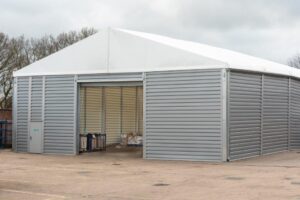 For many businesses, the amount of space they need is rarely constant. Seasonal peaks, new contracts, refurbishment projects, changes in production or an unexpected increase in stock can all create a requirement for additional capacity — sometimes with very little notice.
Building a permanent warehouse is rarely a practical response to a short or medium-term requirement. Renting additional premises elsewhere can solve the problem, but may introduce transport, staffing and logistical complications of its own.
A temporary warehouse structure offers another option: additional covered space installed at or close to your existing premises and configured around the way your business operates.
For organisations in Hampshire, Surrey, London and across the South of England, temporary structures can provide a particularly flexible way to increase storage or operational capacity without committing immediately to permanent development.
What is a temporary warehouse?
A temporary warehouse is a robust, modular structure designed to provide additional covered space for commercial or industrial use. Unlike a conventional building, it can be installed relatively quickly and, depending upon the project, used for anything from a short-term requirement to a considerably longer period.
Modern frame structures can accommodate a wide range of requirements, including storage, production, distribution and operational space. Four Seasons Marquees can provide temporary structures from 2 metres to 20 metres wide, with length adjusted according to the available site and capacity required.
They can be installed on grass or hardstanding and can also be connected to an existing building, creating additional space exactly where it is needed.
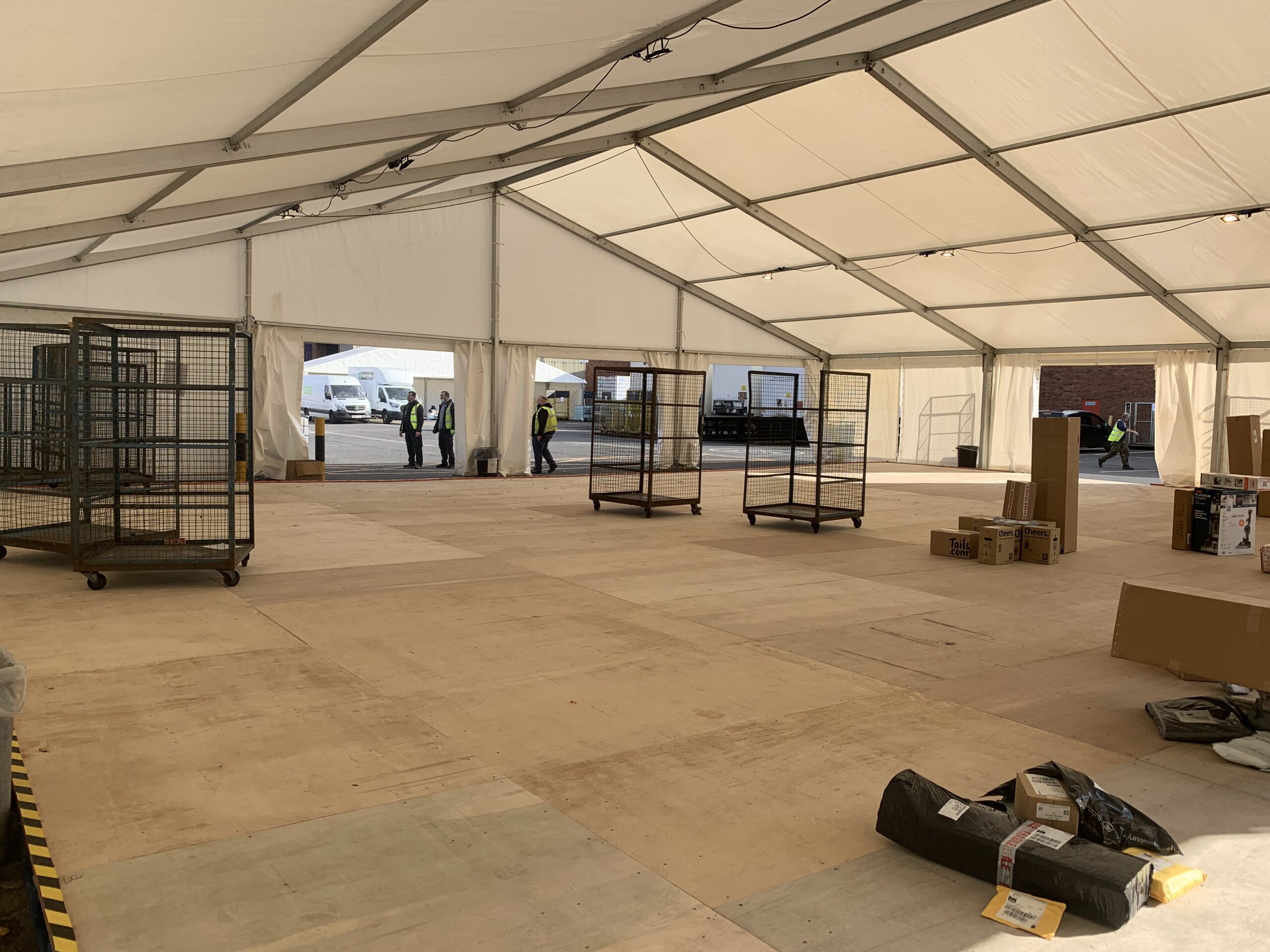
When might your business need extra warehouse space?
There is no single reason for choosing temporary storage. In many cases, the requirement arises because a successful or changing business has simply outgrown its available space.
Seasonal peaks in stock
Retailers, distributors, manufacturers and other businesses can experience significant fluctuations in stock levels throughout the year.
Christmas trading is an obvious example, but seasonal demand can occur in almost any sector. Holding additional stock for a relatively short period does not necessarily justify investing in a permanent warehouse.
A temporary warehouse can provide extra capacity during the peak period and potentially be removed when demand returns to normal.
A new contract or increase in orders
Winning a substantial new contract is good news, but it can put immediate pressure on existing facilities.
Additional raw materials may need to be stored, production capacity increased or finished goods held before dispatch. If the long-term space requirement is not yet known, committing to permanent premises may be premature.
A temporary structure allows a business to increase capacity while it establishes what the longer-term requirement is likely to be.
Keeping a business running during refurbishment
Warehouse, factory and commercial refurbishment frequently creates a temporary space problem.
Areas may need to be emptied while roofing, flooring, mechanical systems or other parts of a building are replaced. Rather than transferring stock or equipment to an off-site facility, a temporary warehouse can potentially be installed within the existing site.
This keeps goods close to where they are required and can reduce unnecessary movement between separate premises.
The same principle applies during extensions and larger construction projects. Temporary accommodation can provide the breathing space required while permanent facilities are being completed.
Creating additional production or workshop space
Temporary structures do not have to be warehouses in the conventional sense.
For some businesses, the pressure is on operational space rather than storage. A temporary structure could provide room for additional production, assembly, packaging, sorting or workshop activity.
The interior can be configured for its intended use, with options including flooring, lighting, heating, power and different types of access.
Large doors can also be incorporated where forklifts, machinery or vehicles need to enter the structure.
Keeping additional space on your existing site
One of the significant advantages of a temporary warehouse can be its location.
Renting another warehouse several miles away may provide the required square footage, but it also separates stock from the main operation. Goods may have to be transported between sites, stock management becomes more complicated and employees can spend time travelling between premises.
Where suitable land or hardstanding is available, installing a temporary warehouse alongside an existing factory, warehouse or commercial building can keep everything within one operational site.
In some circumstances, the structure can even be linked directly to an existing building to provide a convenient, weather-protected extension.
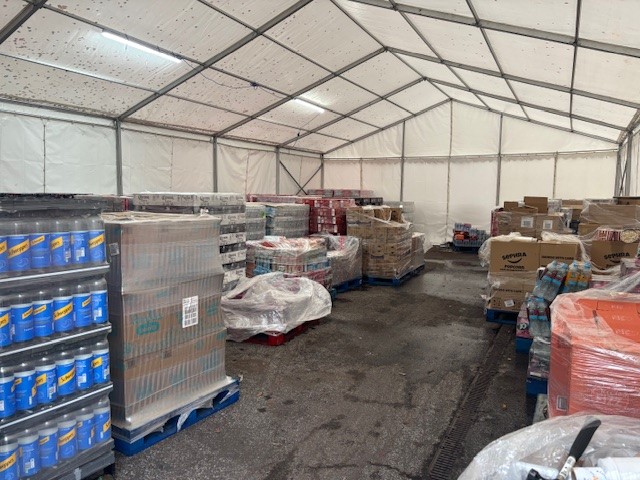
What can be stored in a temporary warehouse?
The answer will depend upon the specification of the structure and the particular storage requirements, but temporary warehouses can be considered for a broad range of commercial uses.
These can include:
- Raw materials and components
- Finished products and packaged stock
- Machinery and equipment
- Vehicles and plant
- Packaging and distribution materials
- Furniture and fixtures
- Stock displaced during refurbishment
- Seasonal or promotional inventory
For businesses storing particularly valuable or sensitive items, the specification should always be considered carefully. Access, flooring, ventilation, heating, lighting and security requirements can all influence the appropriate solution.
Temporary warehouse hire or purchase?
Temporary does not necessarily mean a structure is required for only a few weeks.
Some businesses need additional space for a defined project or seasonal period, while others discover that their requirement is likely to continue for several years.
Four Seasons Marquees offers temporary structures for hire or purchase, allowing the approach to be matched to the anticipated period of use and the organisation’s longer-term plans.
Hiring can make sense where the requirement has a clear end date or where future demand remains uncertain. Purchasing may be worth considering when the additional capacity is expected to become a longer-term part of the operation.
How quickly can a temporary warehouse be installed?
Speed is often one of the reasons businesses consider a temporary structure in the first place.
A permanent building can involve a lengthy process of design, approvals and construction. A temporary structure can potentially provide usable additional space much sooner.
Every project is different, however. The installation programme will depend upon factors including the size and specification of the structure, ground conditions, access to the site and the facilities required inside.
Where the requirement is urgent, Four Seasons Marquees can assess the site and advise on what is realistically achievable.

What happens if the site becomes wet or difficult to access?
The warehouse itself is only part of the equation. Vehicles, forklifts, installation teams and deliveries must also be able to reach it.
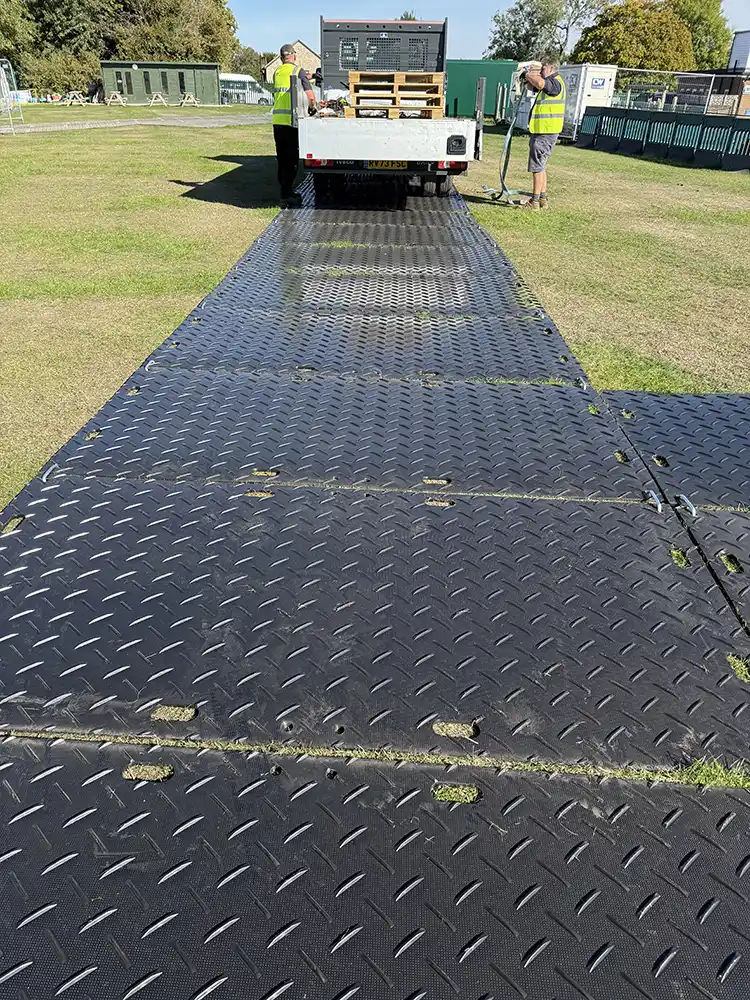
This becomes particularly important when temporary structures are installed on grass or where regular vehicle movements could damage the surrounding ground.
Four Seasons Marquees can provide temporary roadways and trackways to create reliable access and protect vulnerable surfaces. This can be especially valuable during the wetter months or on sites where maintaining the condition of surrounding grounds is important.
It means the structure and its access can be considered as a single project rather than two separate problems.
Planning the right temporary warehouse
Before specifying a temporary warehouse, it is worth looking beyond the amount of floor space required.
Consider what will enter and leave the structure, how frequently that will happen and what equipment will be used. A warehouse receiving palletised deliveries by forklift has very different requirements from one primarily storing vehicles or boxed stock.
Access to the proposed location also matters. Ground conditions, overhead obstructions, surrounding buildings and vehicle movements can all affect the design and installation.
This is why a site assessment can be particularly valuable. Rather than simply selecting a structure of a particular size, the objective is to create additional space that works effectively as part of the existing operation.
Temporary warehouse structures in Hampshire, Surrey and the South of England
Four Seasons Marquees has more than 35 years’ experience providing marquees and temporary structures for commercial, industrial and event applications.
Based in Hampshire, the company works across Hampshire, Surrey, London and the wider South of England, providing structures tailored to individual sites and operational requirements.
Whether extra capacity is required to accommodate seasonal stock, support a refurbishment, respond to a new contract or expand an existing operation, a temporary warehouse can provide valuable additional space without immediately committing to a permanent building.
The starting point is understanding how much space you need, what you intend to use it for and how long you are likely to need it. From there, the structure, access and internal specification can be designed around the business rather than the other way around.
Frequently Asked Questions
What is a temporary warehouse structure?
A temporary warehouse is a modular structure that provides additional covered storage or operational space without constructing a conventional permanent building. It can be installed on suitable grass or hardstanding and configured to suit the requirements of the business.
What size temporary warehouse can I have?
Four Seasons Marquees can provide temporary structures from approximately 2 metres to 20 metres wide, with the length configured according to the capacity required and the available site.
Can a temporary warehouse be attached to an existing building?
Yes. Depending on the building and site, a temporary structure can be linked to existing premises to create additional covered space alongside the current warehouse, factory or commercial building.
Can temporary warehouses be installed on concrete or tarmac?
Yes. Frame structures can be installed on suitable hard surfaces as well as grass. The precise installation method will depend upon the structure, surface and site conditions.
Can I use a temporary structure for something other than storage?
Yes. Temporary structures can provide additional production, workshop, sorting, distribution and other operational space. Flooring, lighting, heating, power and appropriate access can be incorporated according to the intended use.
Can I hire a temporary warehouse rather than buy one?
Yes. Four Seasons Marquees offers temporary structures for both hire and purchase, making them suitable for short-term requirements as well as businesses looking for a longer-term solution.
Can temporary roadways be provided with the warehouse?
Yes. Where vehicle access or ground protection is required, temporary roadway and trackway systems can be provided as part of the project. This can be particularly useful on grass, soft ground and sites affected by prolonged wet weather.